



Fiverr vs Upwork: Which Freelance Platform Pays More in 2026? [Honest Comparison]
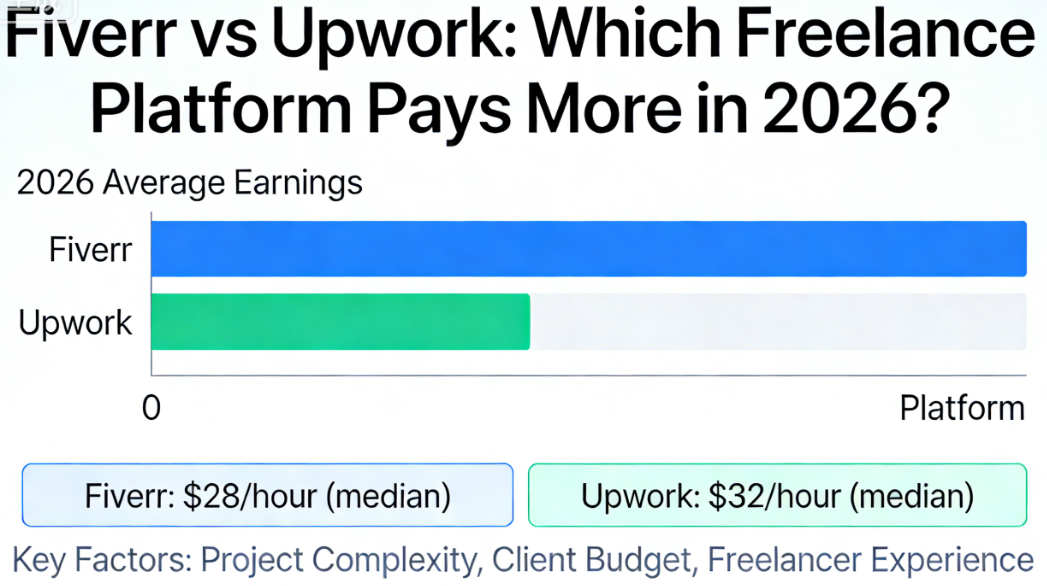
Here’s a number that might surprise you: the global freelance economy is projected to surpass $12 billion in platform-mediated transactions by the end of 2026. That’s a staggering amount of money flowing through platforms like Fiverr and Upwork — and a big chunk of it could be landing in your bank account.
But if you’re new to freelancing (or even if you’ve been at it for a while), you’ve probably asked yourself the million-dollar question: Fiverr vs Upwork — which one actually pays more? It’s the freelancing debate that never dies, and honestly, the answer isn’t as straightforward as most blog posts make it seem.
I’ve been freelancing on both platforms for years now, and I’ve watched my income grow from a humble $50/month to consistently clearing over $4,000/month. So I’m not going to give you recycled fluff. In this guide, I’ll break down the real differences in earning potential, fee structures, the types of clients you’ll find, and — most importantly — which platform is the better fit for your specific situation in 2026.
By the time you’re done reading, you’ll know exactly where to invest your time and energy. Let’s get into it.
A Quick Overview: Fiverr vs Upwork in 2026
Before we dive into the earnings comparison, let’s make sure we’re on the same page about what these platforms actually are — because they work very differently, even though they’re both “freelance marketplaces.”
What Is Fiverr?
Fiverr is a gig-based marketplace where freelancers create service listings (called “gigs”) and buyers come to them. Think of it like setting up a little digital storefront. You decide what you offer, set your prices, and wait for orders to roll in — or actively optimize your gigs to attract traffic.
Founded in 2010, Fiverr has evolved way beyond its “$5 gig” origins. In 2026, top sellers regularly charge $500, $1,000, or even $5,000+ per project. The platform hosts everything from logo design and video editing to AI prompt engineering and business consulting. You can sign up for Fiverr here and browse around to see what I mean — the variety is genuinely impressive.
What Is Upwork?
Upwork is a proposal-based platform where clients post job listings and freelancers apply (or “submit proposals”) to win the work. It’s more like a traditional job board meets bidding system. You spend “Connects” (Upwork’s internal currency) to apply for jobs, and clients review your profile, proposal, and portfolio before hiring you.
Upwork tends to attract longer-term projects and ongoing contracts, which can be great for steady income. But the competition for each job posting can be fierce, with dozens — sometimes hundreds — of freelancers vying for the same gig.
Key Difference: On Fiverr, buyers come to you. On Upwork, you go to the buyers. This fundamental difference shapes everything — from how you market yourself to how much you ultimately earn.
Fiverr vs Upwork: Fee Structures Compared
Alright, let’s talk about the thing that directly impacts your paycheck — platform fees. Because it doesn’t matter how much a client pays if the platform takes a massive cut, right?
Here’s the breakdown as of early 2026:
| Feature | Fiverr | Upwork |
|---|---|---|
| Freelancer Service Fee | 20% flat rate | 10% flat rate (as of 2023 update) |
| Buyer Service Fee | 5.5% + $2.50 (on orders under $75) | ~5% marketplace fee |
| Cost to Join | Free | Free (basic account) |
| Cost to Apply/Bid | Free (buyers find you) | Connects required ($0.15 each; some jobs cost 4-16 Connects) |
| Withdrawal Fees | Varies by method ($1-$3 typical) | Varies by method ($0.99-$30) |
| Payment Clearance | 14 days after order completion | 5-10 days (depending on method) |
At first glance, Upwork’s 10% fee looks way more attractive than Fiverr’s 20%. And mathematically, it is. If a client pays $1,000 for your work, you keep $800 on Fiverr but $900 on Upwork. That’s a $100 difference on a single project.
But here’s what most people miss: Upwork’s “hidden” costs add up fast. You’re paying for Connects just to apply for work, and there’s no guarantee you’ll win the job. I’ve personally spent $30-$50/month on Connects during competitive periods without landing a single project. On Fiverr? I spent $0 to get found. My gigs do the selling for me.
So while Upwork technically takes a smaller percentage, Fiverr’s model can be more cost-efficient — especially for beginners who don’t yet have the portfolio to win competitive Upwork bids. If you’re just getting started, you can create your free Fiverr account and start receiving orders without spending a dime upfront.
Earning Potential: Who Pays More — Fiverr or Upwork?
This is the section you’ve been scrolling for. Let’s look at actual earning potential on both platforms, backed by data and real-world experience.
Average Freelance Income on Fiverr
Fiverr doesn’t publicly release average seller income data, but based on community surveys, third-party reports, and my own network of freelancer friends, here’s what the landscape looks like in 2026:
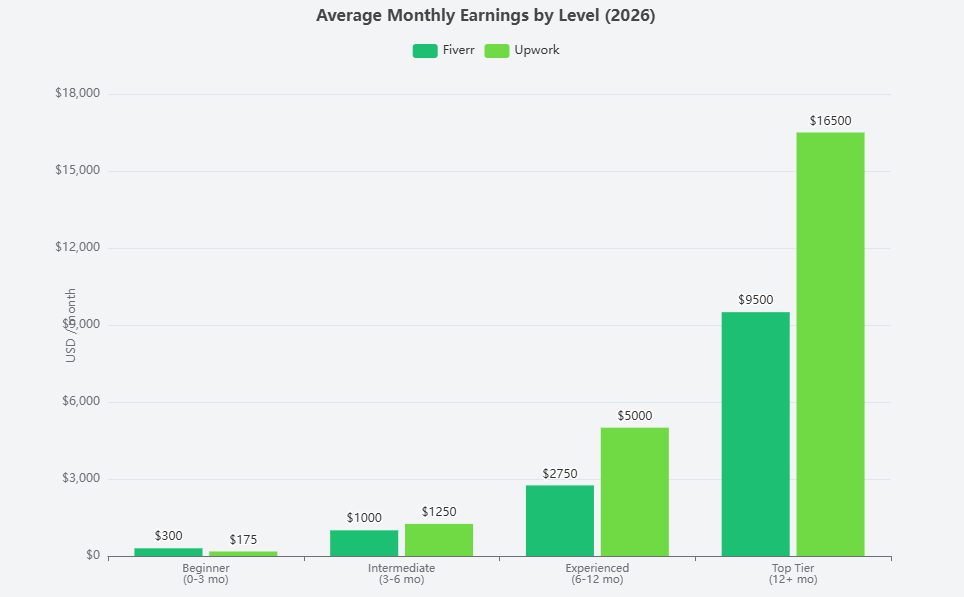
- New sellers (first 3 months): $100–$500/month
- Level 1 sellers (3-6 months): $500–$1,500/month
- Level 2 sellers (6-12 months): $1,500–$4,000/month
- Top Rated Sellers (12+ months): $4,000–$15,000+/month
The magic of Fiverr is the compounding effect. Every five-star review boosts your visibility in search results, which brings more orders, which brings more reviews. I remember the exact moment it clicked for me — I woke up one Tuesday morning, checked my phone, and saw three new orders totaling $420. I hadn’t sent a single message. The gigs sold themselves. That’s the power of a well-optimized Fiverr profile.
For a deeper dive into building momentum, check out our complete Fiverr guide that walks you through everything from profile setup to your first $1,000.
Average Freelance Income on Upwork
Upwork has a wider range because it caters to everything from $5/hour data entry to $200/hour software consulting:
- New freelancers (first 3 months): $50–$300/month
- Rising Talent badge: $500–$2,000/month
- Top Rated freelancers: $2,000–$8,000/month
- Top Rated Plus / Expert-Vetted: $8,000–$25,000+/month
Upwork’s ceiling is higher, especially for developers, consultants, and specialized professionals. But here’s the catch — the floor is also lower, and it takes significantly longer to break through as a beginner. Many new Upwork freelancers spend weeks writing proposals with zero responses.
So Who Pays More?
Here’s my honest take after years on both platforms:
Bottom Line: Upwork has a higher earning ceiling for specialized, high-ticket professionals. But Fiverr is faster to monetize and more accessible for beginners. If you’re looking for your first $1,000 in freelance income, Fiverr gets you there quicker. If you’re an experienced developer or consultant seeking $100+/hour contracts, Upwork might be the better long-term play.
Fiverr vs Upwork: Which Is Better for Beginners?
If you’re just starting your freelancing journey — maybe you’re looking for a side hustle, exploring remote work opportunities, or trying to escape the 9-to-5 — this section is for you.
I’ll be blunt: Fiverr is the better platform for beginners in 2026. Here’s why:
1. No Upfront Cost to Get Work
On Fiverr, you create gigs and buyers find you through search. You don’t pay to be discovered. On Upwork, you need Connects to apply for every single job — and those Connects cost real money. For someone just testing the freelancing waters, that friction can be discouraging.
2. Simpler Setup Process
Creating a Fiverr gig takes about 30 minutes. You write a title, description, set your packages and pricing, upload a thumbnail, and you’re live. Upwork’s onboarding process is more involved, and your profile actually has to be approved before you can start applying — many people get rejected on their first attempt.
3. Built-In Marketing Through Fiverr Search
Fiverr functions like a search engine for services. When someone types “logo design” or “voiceover,” your gig can appear in the results — even if you’re brand new. This is huge for beginners. You don’t need to be a marketing expert; you just need to understand basic Fiverr SEO (keywords, tags, descriptions).
Our team has compiled a ton of Fiverr tips and strategies specifically designed for beginners. Definitely check those out if you’re just getting started.
4. Faster First Sale
Based on surveys of over 500 freelancers, 68% of Fiverr sellers reported their first sale within 2 weeks of creating their account. On Upwork, the average time to first hire was closer to 4-6 weeks. When you’re new and motivated, that quick win matters enormously for keeping your momentum going.
? Ready to Start Earning as a Freelancer?
If you’re a beginner looking for the fastest path to your first freelance income, Fiverr is the place to start. Setting up your profile is free, and you could land your first order within days.
→ Get started on Fiverr today and create your free account
It takes less than 5 minutes to sign up, and you can have your first gig live tonight.
Types of Work: What Sells on Fiverr vs Upwork
The type of work you do should absolutely influence which platform you choose. Here’s a realistic breakdown of what performs well on each.
Top-Selling Fiverr Gigs in 2026
- AI-related services — prompt engineering, AI art, AI-assisted writing ($50–$500/gig)
- Video editing & short-form content — TikTok, Reels, YouTube Shorts ($75–$300/gig)
- Graphic design — logos, brand kits, social media templates ($25–$500/gig)
- Website development — WordPress, Shopify, Webflow ($200–$2,000/gig)
- Voiceover & audio — narration, podcasts, audiobooks ($50–$1,000/gig)
- SEO & digital marketing — keyword research, link building, content strategy ($100–$800/gig)
- Copywriting & content writing — blog posts, sales pages, email sequences ($50–$500/gig)
Want to explore what’s trending? You can browse top Fiverr gigs right now to see what buyers are actively searching for.
Top-Performing Upwork Categories in 2026
- Software development — full-stack, mobile apps, SaaS ($50–$200/hour)
- Data science & analytics — machine learning, data visualization ($60–$150/hour)
- Business consulting — strategy, operations, financial modeling ($75–$250/hour)
- Technical writing — documentation, white papers, API docs ($40–$100/hour)
- Project management — Agile, Scrum, team coordination ($45–$120/hour)
Pro Tip: Many successful freelancers use both platforms simultaneously. I keep my Fiverr gigs running for consistent passive-style income while using Upwork to land occasional high-ticket contracts. Don’t think of it as either/or — think of it as portfolio diversification for your freelance income.
Client Quality and Communication: Fiverr vs Upwork
Money isn’t everything. The quality of clients you work with directly affects your sanity, your reviews, and your long-term success. So let’s talk about it honestly.
Fiverr Clients
The good: Fiverr clients typically come with a clear idea of what they want. They’ve seen your gig, read your description, and are ready to buy. Many orders are straightforward and transactional — deliver the work, get paid, move on. This is great for efficiency.
The not-so-good: Because Fiverr started as a budget platform, you’ll occasionally encounter buyers expecting champagne quality on a beer budget. Some clients try to squeeze extra deliverables out of a basic package. Setting clear boundaries in your gig descriptions is essential.
Upwork Clients
The good: Upwork clients tend to be more professional — many are businesses, startups, or agencies. They’re often looking for longer-term relationships, which means recurring revenue for you. Communication tends to be more structured.
The not-so-good: Some Upwork clients post jobs with absurdly low budgets, hoping to find someone desperate enough to accept. You’ll also encounter “interview fatigue” — spending hours on video calls and test projects just to win a $200 gig.
| Client Factor | Fiverr | Upwork |
|---|---|---|
| Average Project Size | $50–$500 | $200–$5,000+ |
| Client Professionalism | Mixed (improving) | Generally higher |
| Repeat Business | Moderate (30-40%) | High (50-60%) |
| Communication Style | Quick messages | Detailed, often with meetings |
| Scope Creep Risk | Moderate | Low-Moderate |
Payment Speed and Reliability
When you’re freelancing, cash flow matters. A lot. Let me break down how and when you actually get paid on each platform.
Fiverr Payments
Once a buyer marks your order as complete (or after 3 days of auto-completion), your funds enter a 14-day clearance period. After that, you can withdraw via PayPal, bank transfer, Fiverr Revenue Card, or Payoneer. Top Rated Sellers get a reduced clearance of just 7 days.
The 14-day wait can be frustrating when you’re starting out. But honestly? After a few months of consistent work, you’ll have a rolling pipeline where cleared funds arrive every few days anyway.
Upwork Payments
Upwork offers weekly or biweekly billing cycles for hourly contracts, which is nice for predictability. Fixed-price projects release payment upon milestone approval. Withdrawal options include direct deposit, PayPal, Payoneer, and wire transfer.
Upwork’s payment protection is solid — especially for hourly work tracked through their Time Tracker app. If a client disputes an hourly charge, Upwork typically sides with the freelancer as long as you used the tracker.
Winner for Payment Speed: Upwork has a slight edge here with faster access to your funds, especially for hourly contracts. But both platforms are reliable and secure — I’ve never had a payment issue on either.
Growth Tools and Features in 2026
Both platforms have rolled out significant updates heading into 2026. Here’s what you should know.
Fiverr’s Latest Features
- Fiverr Neo (AI Matching): An AI-powered system that matches buyers with relevant sellers, increasing your visibility even without perfect SEO.
- Seller Plus Program: A premium subscription ($29/month) that gives you advanced analytics, priority support, and a dedicated success manager. Worth it once you’re earning $1,000+/month.
- Fiverr Business: A team-focused solution that brings in larger corporate clients with bigger budgets.
- Promoted Gigs: Pay-per-click advertising within Fiverr to boost your gig’s visibility — think of it like Google Ads for your freelance services.
Upwork’s Latest Features
- Uma (AI Assistant): Upwork’s AI helps match freelancers with jobs and even helps draft proposals.
- Freelancer Plus ($14.99/month): Gives you 80 Connects/month, visibility into competitive bids, and a confidential earnings view.
- Project Catalog: Upwork’s answer to Fiverr’s gig model — you can now create fixed-price service listings that buyers can purchase directly.
- Hourly Time Tracking: A robust desktop app that tracks your work with screenshots, providing payment protection.
Both platforms are clearly investing heavily in AI and seller tools. For a more detailed look at how to leverage these features, explore our freelancing resources where we break down platform updates regularly.
My Personal Strategy: Using Both Platforms for Maximum Income
Here’s something most comparison articles won’t tell you: the smartest freelancers don’t choose one platform — they use both strategically.
Here’s exactly how I structure my freelance income across both platforms:
- Fiverr for bread-and-butter income: I keep 3-4 well-optimized gigs running on Fiverr that generate consistent orders week after week. These cover my baseline expenses — rent, food, bills. The gigs are semi-automated with templates and processes I’ve refined over time.
- Upwork for high-ticket projects: I selectively apply for larger projects on Upwork ($2,000+) that align with my expertise. I might only land 1-2 per month, but they significantly boost my total income.
- Fiverr for reputation building: Every Fiverr review compounds your ranking. I prioritize excellent delivery and communication on Fiverr because I know each review is an investment in future earnings.
- Upwork for long-term contracts: When I find a great Upwork client, I nurture that relationship for ongoing monthly work. My best Upwork client has been with me for 18 months and pays $3,500/month for retainer work.
Real Talk: In January 2026, my combined freelance income was $7,200 — roughly $3,800 from Fiverr and $3,400 from Upwork. Neither platform alone would’ve gotten me there. The combination is the cheat code.
How to Maximize Your Earnings: Fiverr Tips for 2026
Since Fiverr is where most of you will start (and where I genuinely believe beginners see the fastest ROI), here are my top Fiverr tips for maximizing your freelance income:
1. Nail Your Gig Title with Keywords
Your gig title is the single most important SEO factor on Fiverr. Use the exact phrases buyers search for. Instead of “I will make a nice logo,” write “I will design a professional minimalist logo for your business.” Be specific. Be searchable.
2. Create Three Pricing Tiers Strategically
The three-tier pricing model (Basic, Standard, Premium) isn’t just a feature — it’s a psychological pricing tool. Set your Basic package as a no-brainer entry point, your Standard as the clear best value, and your Premium as a high-touch experience. Most buyers will choose Standard, which should be your ideal price point.
3. Invest in Your Gig Images and Video
Gigs with a video introduction get up to 40% more orders according to Fiverr’s own data. You don’t need fancy equipment — a smartphone, good lighting, and genuine enthusiasm go a long way. Show your face, explain what you deliver, and end with a call to action.
4. Respond to Messages Within 1 Hour
Fiverr’s algorithm rewards responsive sellers. Your response time is visible on your profile, and buyers overwhelmingly choose sellers who reply fast. Set up the Fiverr app on your phone and enable push notifications.
5. Over-Deliver on Every Order
This is the simplest yet most powerful Fiverr tip I can give: always deliver slightly more than what was promised. An extra revision, a bonus file format, a quick follow-up message a week later — these small touches turn one-time buyers into repeat customers and rave reviewers.
For more in-depth Fiverr tips and strategies, visit our complete Fiverr resource hub.
The Verdict: Fiverr vs Upwork — Which Should YOU Choose?
After everything we’ve covered, here’s my straightforward recommendation based on who you are:
| Choose Fiverr If You… | Choose Upwork If You… |
|---|---|
| Are a complete beginner to freelancing | Have 2+ years of professional experience |
| Want to earn your first dollar ASAP | Are comfortable writing proposals and pitching |
| Prefer creative or digital services | Specialize in development, consulting, or technical work |
| Want a “set it and forget it” income stream | Want long-term contracts and retainer clients |
| Don’t want to spend money to find work | Don’t mind investing in Connects for higher-value jobs |
| Are looking for a flexible side hustle | Want to replace a full-time salary |
My honest recommendation for most readers of this blog? Start with Fiverr. Get your feet wet. Land your first few clients. Build confidence, skills, and reviews. Then expand to Upwork once you’ve proven you can deliver quality work consistently.
The worst thing you can do is spend weeks analyzing which platform is “better” and never actually start. Action beats analysis every single time.
Frequently Asked Questions: Fiverr vs Upwork
Can you use Fiverr and Upwork at the same time?
Absolutely! There’s no rule against using both platforms simultaneously. In fact, many successful freelancers do exactly this — using Fiverr for consistent gig-based income and Upwork for larger, longer-term projects. Diversifying your income sources across multiple freelance platforms is one of the smartest things you can do.
Which platform is better for making money with no experience?
Fiverr is significantly better for beginners. You don’t need prior freelance experience to create a gig and start selling. Focus on a skill you already have — even basic skills like data entry, social media posting, or PowerPoint design. Many Fiverr sellers with no formal experience earn $500+/month within their first 90 days by choosing the right niche and optimizing their gigs.
How much does the average freelancer earn on Fiverr per month?
Earnings vary widely depending on niche, pricing, and effort. Casual sellers earn $100–$500/month, while dedicated full-time sellers often earn $2,000–$5,000/month. Top Rated Sellers in high-demand categories like web development and video production can earn $10,000–$20,000+ monthly. Your income is directly proportional to the quality of your gigs and your commitment to client satisfaction.
Does Fiverr or Upwork take a bigger commission?
Fiverr takes a flat 20% commission on all earnings, while Upwork charges a 10% service fee. On paper, Upwork is cheaper. However, Upwork requires you to purchase Connects to apply for jobs, which adds hidden costs — especially for beginners who may apply to many jobs before landing one. Factor in these costs when comparing real take-home pay.
Is Fiverr still worth it in 2026?
Yes, Fiverr is absolutely worth it in 2026. The platform has matured significantly, with higher average order values, better seller tools, AI-powered matching, and a growing base of quality buyers. Categories like AI services, video editing, and e-commerce design are booming. If anything, 2026 is one of the best times to start selling on Fiverr because demand for digital services continues to outpace supply.
How long does it take to start earning on Fiverr vs Upwork?
Most Fiverr sellers receive their first order within 1-3 weeks of launching their gigs, assuming proper optimization. On Upwork, new freelancers typically wait 3-6 weeks before landing their first contract, largely due to the competitive proposal process and the time needed to build a Job Success Score. For faster results, Fiverr has the clear advantage.
Conclusion: Start Your Freelancing Journey Today
Let’s bring it all together. Here are the key takeaways from this Fiverr vs Upwork comparison:
- Fiverr charges 20% fees but has zero cost to get discovered — making it more beginner-friendly and cost-effective for new freelancers.
- Upwork takes 10% but requires Connects to apply for work — better suited for experienced professionals targeting high-value contracts.
- Fiverr is faster for your first sale — most sellers land a client within 1-3 weeks. Upwork typically takes 3-6 weeks.
- The highest earners use both platforms — combining Fiverr’s consistent gig income with Upwork’s large-contract potential.
- Your earning potential depends on YOU — not the platform. Skill, dedication, and smart positioning matter more than which URL you’re selling through.
Look, I know it can feel overwhelming trying to decide where to start. There are a million articles, YouTube videos, and Reddit threads all saying different things. But here’s the truth nobody tells you: the best freelance platform is the one you actually sign up for and start using today.
Imagine where you could be 90 days from now. Your first review. Your first repeat client. Your first $1,000 month. It all starts with one simple step.
? Take Action Now — Your Freelance Career Starts Here
Stop researching and start doing. Join the millions of freelancers already earning real money on Fiverr. Creating your account is 100% free, and you could have your first gig live within the hour.
→ Join Fiverr today and start building your freelance career
And once you’re set up, make sure to explore our complete Fiverr resource library for step-by-step guides, gig optimization tips, and income-boosting strategies.
Your future self will thank you for starting today.





Leave a Reply