



How to Price Your Fiverr Gigs: The Ultimate Fiverr Pricing Strategy Guide for Beginners [2026]
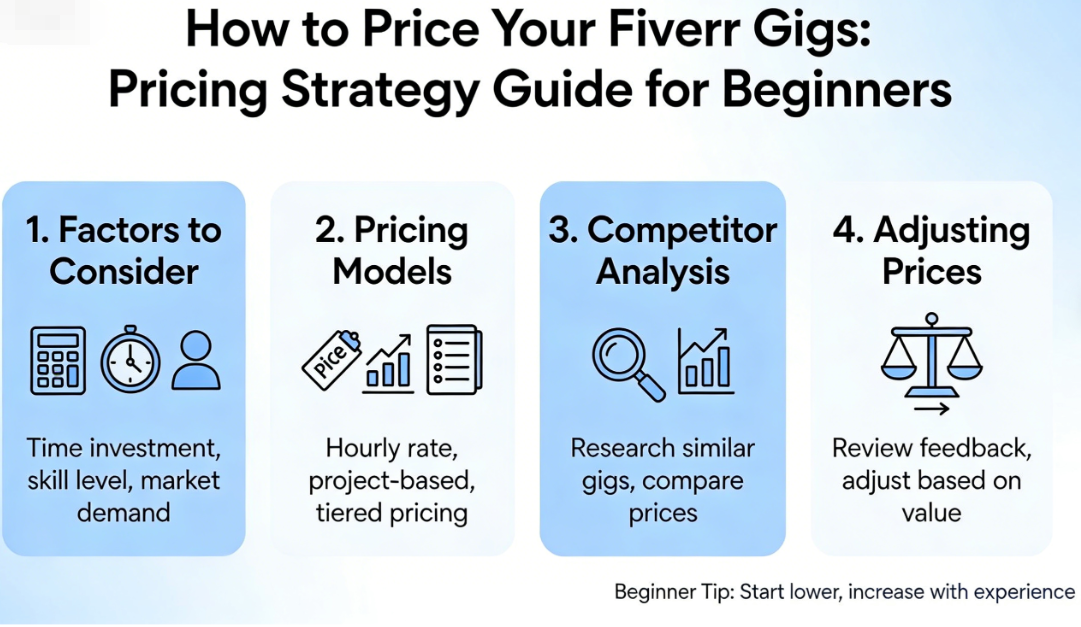
Here’s a number that might surprise you: over 60% of new Fiverr sellers never make it past their first three months on the platform. And the #1 reason? It’s not talent. It’s not marketing. It’s pricing.
If you’ve ever stared at the “Set Your Price” screen and felt completely lost — wondering if you should charge $5 to get your first order or $50 because you know your work is worth it — you’re not alone. Getting your Fiverr pricing strategy right is the single most important decision you’ll make as a new seller, and most beginners get it dead wrong.
The good news? You don’t have to guess. In this guide, I’m going to walk you through exactly how to price your Fiverr gigs so you attract buyers, earn what you deserve, and build a sustainable freelance income. We’ll cover everything from competitive research to package structuring, psychological pricing tricks, and when to raise your rates. Whether you’re brand new or struggling to get consistent orders, this one’s for you.
Let’s make sure your pricing works for you — not against you.
Why Your Fiverr Pricing Strategy Can Make or Break Your Success
Let me be blunt: pricing isn’t just a number you slap on your gig. It’s a signal. It tells buyers who you are, what quality they can expect, and whether they should trust you with their project. Get it wrong, and you’ll either scare people away or burn yourself out doing $5 jobs that should pay $50.
Think about it from the buyer’s perspective. When someone searches for “logo design” on Fiverr and sees prices ranging from $5 to $500, they’re making instant judgments. Too cheap? They assume the work will be terrible. Too expensive for a seller with no reviews? They scroll right past. There’s a sweet spot, and finding it is what separates sellers who make $100 a month from those pulling in $3,000+.
Your pricing also affects the Fiverr algorithm. Gigs that convert well (meaning people actually click and buy) get pushed higher in search results. If your price is off — too high for your level or too low to seem credible — your conversion rate tanks, and Fiverr buries your gig. It’s a vicious cycle.
But here’s what most Fiverr tips articles won’t tell you: the “right” price changes over time. Your pricing strategy on Day 1 should look completely different from your strategy at 50 reviews. This guide covers the full journey, so if you’re ready to get started on Fiverr, let’s dive in.
Step 1: Research Your Competition (Before You Set a Single Price)
Before you even think about numbers, you need to do your homework. Competitive research is the foundation of every smart Fiverr pricing strategy, and it takes about 30 minutes to do properly.
How to Analyze Competitor Pricing on Fiverr
Here’s the exact process I recommend:
- Search for your service using the keywords buyers would use (e.g., “WordPress website design” or “podcast editing”)
- Filter by “Best Selling” to see what top performers charge
- Open 10-15 gigs across different seller levels (New Seller, Level 1, Level 2, Top Rated)
- Record their pricing for Basic, Standard, and Premium packages
- Note what’s included at each price point — deliverables, revisions, delivery time
Create a simple spreadsheet with this data. You’ll start to see patterns emerge. For example, you might discover that Basic logo design gigs from Level 2 sellers average $35-$65, while new sellers with similar quality charge $15-$25.
What to Look For
Pay attention to more than just the dollar amount. Ask yourself:
- What do top sellers include in their Basic package versus their Premium?
- How do sellers with 100+ reviews price differently from those with 10?
- What’s the price gap between each package tier?
- Are there any services that seem underpriced or overpriced relative to the work involved?
This research gives you a realistic pricing range for your niche. Don’t skip it — guessing your price is like throwing darts blindfolded. For a deeper dive into getting set up, check out our complete Fiverr guide which covers everything from profile optimization to landing your first sale.
Step 2: Understand Fiverr’s Fee Structure (So You Don’t Underprice)
This is where so many Fiverr for beginners go wrong. They set a price without accounting for what they’ll actually take home. Let me break it down.
Fiverr takes a 20% commission on every order. That means if you charge $100 for a gig, you receive $80. If you charge $5, you get $4. And depending on your withdrawal method, there may be additional processing fees ($1-$3 per withdrawal for most methods).
Here’s what this looks like in practice:
| Gig Price | Fiverr’s 20% Fee | Your Earnings | After Withdrawal Fee (~$2) |
|---|---|---|---|
| $5 | $1 | $4 | $2 |
| $25 | $5 | $20 | $18 |
| $50 | $10 | $40 | $38 |
| $100 | $20 | $80 | $78 |
| $250 | $50 | $200 | $198 |
| $500 | $100 | $400 | $398 |
See that $5 gig? After fees, you’re walking away with roughly $2. Unless you can complete that work in under 10 minutes, you’re literally earning less than minimum wage. This is why I always tell new sellers: factor in the 20% fee before you set your price, not after.
💡 Key Takeaway: When calculating your gig price, start with the amount you want to earn, then add 25% to cover Fiverr’s fee. Want to earn $40 per order? Price your gig at $50. Want $200? Price at $250. Simple math, but it changes everything.
Don’t forget to account for your time, too. Track how long each type of project takes you and calculate your effective hourly rate. If a $25 gig takes you 3 hours, you’re earning about $6.67/hour after Fiverr’s cut. Not exactly the freelance income dream, right?
Step 3: Set Your Starter Price (The New Seller Strategy)
Okay, here’s where things get real. You’re new. You have zero reviews. And you’re up against sellers with hundreds of 5-star ratings. How do you compete?
You compete on price — but strategically, not desperately.
The “Slightly Below Average” Approach
Based on the competitive research you did in Step 1, I recommend new sellers price their Basic package at 10-30% below the average for established sellers in their category. Not rock-bottom. Not free. Just enough to make a buyer think, “Hmm, that’s a good deal for what I’m getting.”
For example, if Level 2 sellers charge $50 for a Basic logo package, you might start at $25-$35. Here’s the logic:
- It’s low enough to attract budget-conscious buyers willing to take a chance on a new seller
- It’s high enough to signal that you take your work seriously
- It gives you room to raise prices after you collect your first 10-20 reviews
The $5 Trap: Don’t Fall Into It
I know it’s tempting. “If I just charge $5, I’ll get tons of orders and build up my reviews fast!” I thought the same thing when I started. And sure — you might get orders. But here’s what actually happens:
- You attract the most demanding, difficult-to-please buyers (the ones spending $5 often expect $500 of value)
- You burn out fast doing quality work for pocket change
- When you try to raise your prices later, your existing audience disappears because they only wanted cheap
- Your effective hourly rate makes fast food look like investment banking
The only time a $5 entry price makes sense is if you’re offering something truly quick and simple — like a 50-word product description or a basic social media graphic from a template. Even then, I’d push you toward $10-$15 minimum.
If you haven’t set up your seller account yet, now’s a great time to create your free Fiverr account and start browsing gigs in your niche to get a feel for the market.
Step 4: Master Fiverr’s 3-Tier Package System
This is where a smart Fiverr pricing strategy really comes alive. Fiverr allows you to create three package tiers — Basic, Standard, and Premium — and how you structure these can dramatically increase your average order value.
The Psychology Behind Three Tiers
There’s a well-documented psychological principle called the “decoy effect” (also known as the anchoring effect). When people see three options, they overwhelmingly choose the middle one. Your Standard package isn’t just another option — it’s your money-maker.
Here’s the framework I recommend:
| Package | Purpose | Pricing Approach | Example (Logo Design) |
|---|---|---|---|
| Basic | Entry point / lead magnet | Minimum viable service | 1 logo concept, 1 revision — $30 |
| Standard | Best value (your target sale) | 2x-3x Basic price | 3 concepts, 3 revisions, source file — $75 |
| Premium | Anchor / high-end option | 2x-3x Standard price | 5 concepts, unlimited revisions, full brand kit — $150 |
How to Structure Each Tier
Basic Package: Keep this lean. Include just enough to deliver a complete result, but leave the buyer wanting more. Think of it as the “taste test.” One revision, longer delivery time, basic scope.
Standard Package: This is where you load in the value. More revisions, faster delivery, additional deliverables. The gap between Basic and Standard should feel like a no-brainer upgrade. Buyers should look at both and think, “I’d be silly not to spend a little more.”
Premium Package: Go all out. This is your VIP treatment. Priority delivery, maximum revisions, extra deliverables, source files — everything. Even if only 10-15% of your buyers choose this tier, it dramatically increases your average revenue per order.
🎯 Pro Tip: Make your Standard package name compelling. Instead of just “Standard,” call it “Most Popular” or “Best Value” in the description. Fiverr even lets you highlight this visually, and it nudges more buyers toward it.
Ready to Start Earning on Fiverr? 🚀
If you’ve been on the fence about freelancing, there’s never been a better time to jump in. Fiverr connects you with millions of buyers worldwide who need your skills — whether that’s writing, design, programming, marketing, or dozens of other services.
Sign up for Fiverr here and start building your gig today. It’s completely free to join, and you could land your first order within days.
Step 5: Use Gig Extras and Add-Ons to Boost Your Income
Here’s a secret that top Fiverr sellers know: your gig price is just the starting point. The real money is in the extras.
Fiverr allows you to add optional upgrades to every order. These are pure profit boosters, and buyers use them more often than you’d think. Some sellers report that gig extras account for 30-50% of their total revenue.
High-Converting Gig Extras to Offer
- Extra-fast delivery: Charge 25-50% more to deliver in 24 hours instead of 3 days
- Additional revisions: $10-$25 for extra rounds of changes
- Source files: $15-$50 for editable files (PSD, AI, DOCX, etc.)
- Additional concepts/versions: $20-$40 per additional option
- Commercial use rights: $25-$75 depending on the project
- Extended support: $15-$30 for 30 days of post-delivery support
The beauty of gig extras is that the buyer has already committed to purchasing. They’re in “buying mode.” Adding a $15 extra to a $50 order feels small — but it’s a 30% increase in your revenue from that single transaction.
For more ideas on optimizing your gigs and maximizing earnings, check out more Fiverr tips on our resource hub.
Step 6: Pricing Psychology Hacks That Work on Fiverr
Let’s get a little nerdy for a minute — because pricing psychology is a real thing, and it works incredibly well on freelance platforms like Fiverr.
Charm Pricing ($49 vs. $50)
You’ve seen this in every store: things priced at $9.99 instead of $10. It works because our brains process the first digit first. On Fiverr, price your gigs at $45 instead of $50, or $95 instead of $100. The perceived difference is bigger than the actual difference.
Anchoring With Your Premium Package
When buyers see your Premium package at $200, your Standard package at $75 suddenly looks like a bargain. This is anchoring — and it’s the main reason your Premium tier exists. Even if nobody buys it, it makes your other packages look more attractive.
The Power of Odd Numbers
Prices like $37, $67, or $147 tend to feel more deliberate and carefully calculated than round numbers. They suggest you’ve thought carefully about the value — because who randomly picks $37? (You did. But they don’t know that.)
Value Framing in Your Description
Don’t just list your price — frame the value. If you’re charging $75 for a logo, mention that comparable logos from design agencies cost $500-$2,000. If your $50 blog post would take the buyer 6 hours to write themselves, point out that their time is worth more than $8/hour.
💡 Key Takeaway: Pricing isn’t just math — it’s psychology. The way you present your prices matters just as much as the numbers themselves. Use anchoring, charm pricing, and value framing to make your gigs irresistible.
Step 7: Know When (and How) to Raise Your Prices
Your launch price is not your forever price. One of the biggest mistakes I see in the Fiverr freelancing community is sellers who never raise their rates, even after building a stellar reputation. Your prices should grow with your experience.
When to Raise Your Prices
Here are clear signals that it’s time for a price increase:
- You’ve hit 10-15 five-star reviews — Social proof now works in your favor
- Your order queue is consistently full — High demand = time to charge more
- You’ve earned a seller level (Level 1, Level 2, Top Rated) — Each level adds credibility
- You’re turning down work because you’re too busy — Classic supply/demand economics
- Buyers are telling you your work is “amazing” or “above expectations” — They’re willing to pay more
How Much to Raise
Don’t double your prices overnight. Increase by 15-25% at each milestone. Here’s a realistic progression for a graphic designer:
| Stage | Reviews | Basic Price | Standard Price | Est. Monthly Income |
|---|---|---|---|---|
| Launch | 0 | $25 | $60 | $200-$400 |
| Level 1 | 10-20 | $35 | $80 | $500-$1,000 |
| Level 2 | 50+ | $50 | $120 | $1,500-$3,000 |
| Top Rated | 100+ | $75 | $175 | $3,000-$6,000+ |
Imagine this: you start today at $25 per gig. Within 6-12 months, with consistent quality and smart pricing moves, you could be charging $75+ for the same type of work. That’s the power of a well-executed Fiverr pricing strategy.
Want to accelerate this journey? Explore our freelancing resources for tips on leveling up faster.
Step 8: Avoid These Deadly Pricing Mistakes
I’ve watched hundreds of sellers sabotage their own success with these common errors. Learn from their mistakes so you don’t have to make them yourself.
Mistake #1: Racing to the Bottom
Competing only on price is a losing game. There will always be someone willing to charge less. Instead, compete on value, quality, and professionalism. A well-crafted gig description, a strong portfolio, and clear communication beat a $5 price tag every time.
Mistake #2: Ignoring Your Niche’s Price Range
Every Fiverr category has its own pricing ecosystem. What works for voice-over artists won’t work for web developers. Always base your prices on category-specific research, not some generic “start at $5” adviceThe 3-tier package system exists for a reason — it lets buyers self-select the level of service they need and increases your average order value significantly.
Mistake #4: Forgetting About Time
A $100 gig that takes 20 hours pays $4/hour after fees. A $40 gig that takes 2 hours pays $16/hour. Always calculate your effective hourly rate and make sure it aligns with your income goals.
Mistake #5: Never Raising Prices
If you’re still charging the same rate after 50 reviews and a Level 2 badge, you’re leaving thousands of dollars on the table every year. Build price increases into your business plan from Day 1.
Fiverr Pricing Strategy by Category: What to Charge in 2026
To give you a concrete starting point, here’s a breakdown of typical pricing ranges for popular Fiverr gigs categories in 2026. These are for Basic packages from sellers with 10-50 reviews:
| Category | New Seller Range | Level 1-2 Range | Top Rated Range |
|---|---|---|---|
| Logo Design | $15-$35 | $40-$80 | $100-$300+ |
| Blog Post Writing (1,000 words) | $20-$40 | $50-$100 | $120-$250+ |
| WordPress Website | $50-$150 | $200-$500 | $500-$2,000+ |
| Video Editing (up to 5 min) | $20-$50 | $60-$150 | $200-$500+ |
| Voice-Over (250 words) | $10-$25 | $30-$75 | $80-$200+ |
| Social Media Management | $50-$100/mo | $150-$400/mo | $500-$1,500+/mo |
| SEO Audit | $25-$50 | $75-$200 | $250-$750+ |
| Translation (500 words) | $10-$20 | $25-$50 | $60-$120+ |
Note: These are estimates based on market research in early 2026. Actual prices vary based on complexity, specialization, and seller quality.
Use these ranges as a starting guideline, then adjust based on your specific sub-niche and the competitive research you’ve done. The key is finding where your skills and experience level place you within these ranges — and then pricing confidently.
Bonus: How to Calculate Your Ideal Fiverr Gig Price
Want a simple formula? Here you go:
Your Ideal Gig Price = (Target Hourly Rate × Hours Per Project) ÷ 0.80
That 0.80 accounts for Fiverr’s 20% commission. Let’s see this in action:
- Target hourly rate: $30/hour
- Average time per project: 3 hours
- Calculation: ($30 × 3) ÷ 0.80 = $112.50
- Your gig price: $115 (rounded to an odd number for that psychological edge)
Now, if you’re brand new and $115 feels too high for your niche, that’s okay. Use this formula for your goal price — the number you’re working toward. Start lower, prove yourself, collect reviews, and steadily climb toward that number.
This kind of intentional, formula-based approach is what separates hobbyists from professionals in the remote work world. You’re running a business, not a charity.
Making It All Work Together: Your 90-Day Pricing Roadmap
Let me bring everything together into a clear action plan. Here’s your Fiverr pricing strategy roadmap for your first three months:
Days 1-30: Launch Phase
- Complete your competitive research (Step 1)
- Set your Basic package at 20-30% below established sellers
- Create compelling 3-tier packages with clear value progression
- Add 3-5 strategic gig extras
- Focus on delivering exceptional work to earn your first 5-10 reviews
Days 31-60: Growth Phase
- Analyze which package tier sells most — optimize accordingly
- Raise your Basic price by 10-15% once you hit 10 positive reviews
- Test different gig extra combinations
- Start tracking your effective hourly rate for each gig
Days 61-90: Optimization Phase
- Another 10-15% price increase if demand stays strong
- Refine your packages based on buyer behavior and feedback
- Consider launching additional gigs at higher price points
- Set your next 90-day pricing goals
Follow this roadmap, and you could realistically go from $0 to $500-$1,000/month in freelance income within your first 90 days. Some sellers hit that mark even faster. It all depends on your niche, quality, and how consistently you show up.
🎯 Your Next Step: Get Started Today
You’ve got the knowledge. You’ve got the strategy. Now it’s time to take action. Every day you wait is a day someone else is landing the clients that could have been yours.
Join Fiverr today — it’s 100% free to create your account and set up your first gig. Use the pricing strategies in this guide, and you could see your first order within the week. Seriously, what are you waiting for?
Frequently Asked Questions About Fiverr Pricing
What is the minimum price for a Fiverr gig in 2026?
The minimum price for a Fiverr gig is $5. However, most experienced sellers recommend starting at $15-$25 minimum, even for simple services. After Fiverr’s 20% commission and withdrawal fees, a $5 gig only nets you about $2 — which isn’t sustainable for quality work. Focus on delivering real value at a fair price instead of racing to the bottom.
How much does Fiverr take from each sale?
Fiverr takes a 20% commission on every completed order. So if you charge $100, you’ll receive $80. This applies to both the base gig price and any gig extras. There may also be small withdrawal processing fees depending on your chosen payment method (PayPal, bank transfer, Fiverr Revenue Card, etc.).
Should I start with low prices on Fiverr to get my first reviews?
Start slightly below average, but not at rock bottom. Pricing your gigs at 10-30% below established competitors in your niche is a smart way to attract early buyers. Going too low ($5) often attracts problematic buyers and undervalues your work. Instead, focus on competitive pricing paired with an outstanding gig description and portfolio samples.
How often should I increase my Fiverr gig prices?
Plan to review your pricing every 30-60 days and increase by 10-25% when you hit milestones. Key triggers for a price increase include reaching 10+ positive reviews, earning a new seller level, having a consistently full order queue, or receiving repeated praise that your work exceeds expectations. Small, regular increases are better than rare, dramatic jumps.
Can I charge different prices for the same type of service on Fiverr?
Absolutely! You can create multiple gigs for similar services with different scopes, specializations, or delivery speeds — each with its own pricing. For example, a writer might have a “Basic Blog Post” gig starting at $30 and a “Premium SEO Article” gig starting at $75. This lets you serve different buyer segments and maximize your freelance income.
What’s the best Fiverr pricing strategy for freelance beginners?
The best Fiverr pricing strategy for beginners is to research your competition, price your Basic package 10-30% below established sellers, create three clear package tiers with strong value progression, add strategic gig extras, and plan gradual price increases as you earn reviews and seller levels. Avoid the $5 trap, always account for Fiverr’s 20% fee, and track your hourly rate to ensure sustainability.
Conclusion: Your Fiverr Pricing Strategy Starts Now
Pricing your Fiverr gigs doesn’t have to be a guessing game. With the right strategy, you can attract quality buyers, earn a real income, and build a freelance career that grows steadily over time.
Let’s recap the key takeaways from this guide:
- Always research your competition before setting prices — data beats guessing every time
- Account for Fiverr’s 20% fee so you don’t accidentally underprice your work
- Use the 3-tier package system strategically, with your Standard package as the star
- Leverage gig extras to increase your revenue by 30-50% per order
- Raise your prices regularly as you build reviews, reputation, and demand
Remember, every Top Rated Seller on Fiverr started exactly where you are right now — at zero reviews, wondering what to charge. The difference between those who succeed and those who quit is simple: the ones who succeed took action.
You’ve read 2,500+ words of proven pricing advice. You know more about Fiverr pricing strategy than 90% of new sellers. Now put it to work.
Create your free Fiverr account here, set up your first gig using the strategies above, and start building the freelance income you deserve. Your future self will thank you for starting today.
And if you want more guidance on succeeding as a Fiverr seller, don’t forget to explore our complete Fiverr resource hub for tips, tutorials, and strategies that work in 2026 and beyond.
Now go price that gig and land your first order. You’ve got this. 💪


Leave a Reply