



Is Fiverr Worth It in 2026? Honest Pros, Cons & Real User Review [+ How I Earned $4,700/Month]
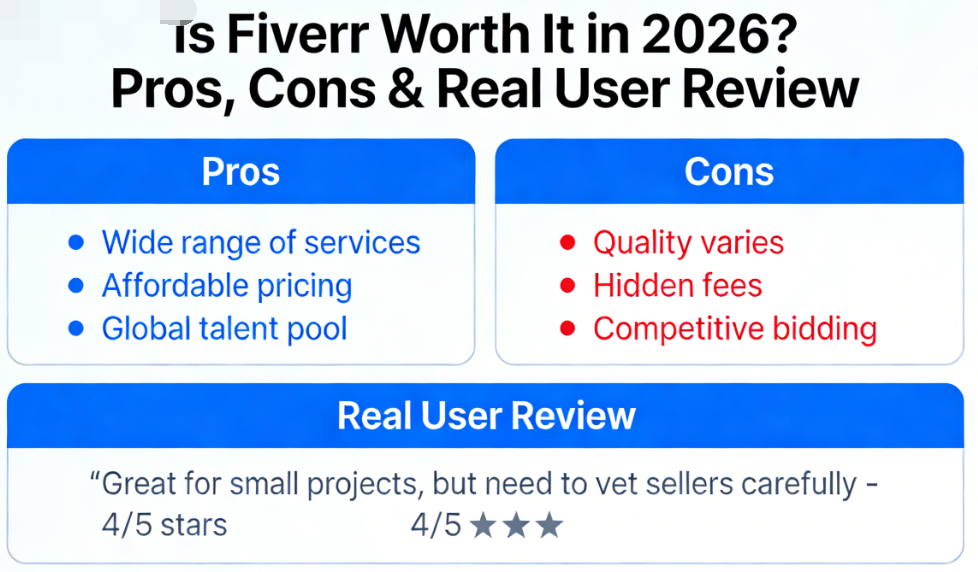
Here’s a number that might surprise you: Fiverr had over 4.2 million active buyers in 2025, and the platform’s annual revenue crossed $380 million. That’s a staggering amount of money flowing between freelancers and clients every single day.
But let’s be real — you’re not here for corporate revenue stats. You’re here because you’ve been wondering: is Fiverr worth it in 2026? Maybe you’ve heard the horror stories — racing to the bottom on pricing, dealing with demanding clients for $5, or spending weeks without a single order. Or maybe you’ve seen the success stories and you’re cautiously optimistic.
I get it. I was in your exact shoes back when I started. Today, after years of freelancing on the platform, I’m pulling in consistent freelance income that lets me work from anywhere with a Wi-Fi connection. But it wasn’t all sunshine and passive income notifications — I made plenty of mistakes along the way.
In this no-BS guide, I’ll share everything: the genuine pros, the frustrating cons, real earnings data, and my best Fiverr tips for actually making this platform work for you in 2026. Whether you’re a complete beginner or you’ve been dabbling for a while, you’ll walk away knowing exactly whether Fiverr deserves your time — and how to maximize it if you decide to jump in.
What Is Fiverr and How Does It Work in 2026?
If you’re brand new, let me break this down simply. Fiverr is a freelance marketplace where sellers (that’s you) create service listings called “gigs,” and buyers (clients from around the world) browse and purchase them. Think of it like an online store, except instead of selling physical products, you’re selling your skills — writing, graphic design, video editing, voiceovers, programming, virtual assistance, and literally hundreds of other digital services.
The platform launched in 2010 with the idea that every service started at $5 (hence the name). But fast-forward to 2026, and that’s ancient history. Today, Fiverr gigs range from $5 to $10,000+ depending on the service and the seller’s expertise. I’ve personally seen web developers charging $5,000 per project and brand strategists earning $2,000 for a single consultation.
How the Fiverr Gig Economy Works
Here’s the basic flow:
- You create a profile and set up gig listings describing your services
- Buyers search for services using Fiverr’s search engine and browse results
- A buyer places an order (or contacts you first to discuss requirements)
- You deliver the work within the agreed timeframe
- Fiverr takes a 20% commission, and you keep the rest
- Funds become available for withdrawal after a clearing period (7-14 days depending on your level)
The big change in 2026? Fiverr has doubled down on AI-powered matching, seller categories, and its “Fiverr Neo” AI assistant that helps buyers find the right freelancer faster. They’ve also expanded Fiverr Business (now called Fiverr Enterprise) for larger companies, which means bigger contracts are flowing onto the platform. If you want to explore the full landscape, check out our complete Fiverr guide for an in-depth overview.
Is Fiverr Worth It? The Honest Pros (What I Love)
Let me start with the good stuff — because there’s genuinely a lot to love about Fiverr when you approach it right.
1. Zero Barrier to Entry
This is huge, especially for Fiverr for beginners. You don’t need a degree, a portfolio full of Fortune 500 clients, or years of experience. You can create your free Fiverr account, set up a gig tonight, and theoretically get your first order this week. I’ve talked to sellers who landed their first client within 48 hours of publishing their gig.
Compare that to cold-emailing businesses, building a website, or networking at events — Fiverr gives you instant access to millions of potential clients without spending a dime on marketing.
2. Built-In Traffic and Trust
When you freelance independently, the hardest part isn’t doing the work — it’s finding the work. Fiverr solves this by acting as a search engine for freelancers. Buyers are already on the platform, credit card in hand, actively looking for someone with your skills. You don’t have to convince them they need a service; you just have to convince them you’re the right person to deliver it.
Fiverr also handles payment processing, dispute resolution, and basic contracts — all the administrative headaches that come with freelancing on your own.
3. Scalable Income Potential
Here’s where it gets exciting. While you might start with $25-$50 gigs, Fiverr’s tier system lets you scale up significantly. With three pricing packages (Basic, Standard, Premium) plus gig extras and custom offers, a single client interaction can easily turn into a $200-$500+ order.
I started with a $35 basic writing gig. Within eight months, my average order value climbed to $185, and by the end of my second year, I was consistently hitting $4,700/month. That’s not overnight riches, but it’s a very real, very livable income — especially if you’re in a country with a lower cost of living.
4. Incredible Variety of Services You Can Sell
Fiverr has expanded way beyond its original creative-services roots. In 2026, you can sell gigs in categories like:
- AI services — prompt engineering, AI tool consulting, ChatGPT integration
- Programming & tech — web development, app creation, cybersecurity
- Digital marketing — SEO, social media management, email marketing
- Writing & translation — blog posts, copywriting, technical writing
- Video & animation — editing, explainer videos, motion graphics
- Business consulting — financial planning, career coaching, market research
- Music & audio — mixing, songwriting, podcast editing
If you have a skill — even one you consider “basic” — there’s likely a buyer for it on Fiverr.
5. The Level System Rewards Consistency
Fiverr’s seller levels (New Seller → Level 1 → Level 2 → Top Rated Seller) are designed to reward consistent, high-quality work. As you climb, you unlock perks like faster payment clearing, more gig slots, higher visibility in search, and the ability to offer gig multiples. It creates a genuine incentive to show up and do great work — and buyers trust higher-level sellers more, which creates a compounding effect on your earnings.
💡 Key Takeaway: Fiverr’s biggest advantage is that it removes the two hardest parts of freelancing — finding clients and getting paid. The platform handles both, so you can focus on what you do best: delivering amazing work.
Is Fiverr Worth It? The Real Cons (What Frustrates Me)
Now, I’d be doing you a disservice if I only talked about the positives. Fiverr has some genuine drawbacks, and you should know about them before investing your time.
1. The 20% Commission Is Steep
Let’s not sugarcoat this. Fiverr takes 20% of every single order. That means if you charge $100, you take home $80. On a $500 project, you’re giving up $100. Over time, that adds up to a significant chunk of your earnings.
For context, Upwork charges 10% (after your first $500 with a client), and platforms like Toptal take their cut from the client side. That said, Fiverr’s commission covers client acquisition, payment processing, and platform maintenance — services that would cost you money to handle independently anyway.
2. The Race-to-the-Bottom Pricing Trap
New sellers often fall into a dangerous trap: pricing their gigs dirt-cheap to compete. When you see 50 people offering logo design for $5-$10, the temptation to match them is overwhelming. But here’s the truth — competing on price is a losing game. You burn out, attract difficult clients, and devalue your skills.
The solution? Compete on quality, niche expertise, and presentation instead. I’ll cover specific strategies for this later in the article.
3. Inconsistent Income (Especially Early On)
Your first few months on Fiverr can feel like shouting into the void. You might go days or even weeks without an order. Then suddenly, you’ll get three in one day. This feast-or-famine cycle is stressful, and it’s the number one reason new sellers quit before they gain traction.
I had months where I earned $2,300 and the very next month dropped to $800. It took about six months of consistent effort before my income stabilized. Patience is not optional on Fiverr — it’s mandatory.
4. Difficult Clients and Unfair Reviews
Let me share a real scenario. I once delivered a 3,000-word blog post that the client loved — they said so in messages. Then they left a 3.8-star review because, quote, “it was good but I expected more.” More what? I’ll never know. That review hurt my ranking for weeks.
Fiverr’s review system gives enormous power to buyers, and while most are fair, a single unreasonable review can genuinely impact your business. There’s limited recourse for sellers, which can feel deeply frustrating.
5. You Don’t Own the Client Relationship
This is the strategic disadvantage that keeps me up at night. On Fiverr, the client belongs to Fiverr, not you. You can’t take clients off-platform (it’s against Terms of Service and can get you banned). If Fiverr changes its algorithm, raises commissions, or shuts down your account, you lose everything you’ve built overnight.
That’s why smart freelancers use Fiverr as one income stream among several — not their entire business.
Fiverr Pros vs. Cons: Quick Comparison
Here’s a side-by-side breakdown to help you weigh the decision:
| ✅ Pros | ❌ Cons |
|---|---|
| Free to join — no upfront costs | 20% commission on all earnings |
| Millions of active buyers already on the platform | Intense competition in popular categories |
| Handles payments, contracts, and disputes | You don’t own the client relationship |
| Level system rewards quality work over time | Income is inconsistent, especially early on |
| Enormous range of service categories | Pressure to underprice your services |
| Work from anywhere, set your own schedule | Unfair reviews can damage your rankings |
| Scalable from side hustle to full-time income | Algorithm changes can tank your visibility |
How Much Can You Actually Earn on Fiverr in 2026?
This is the million-dollar question (sometimes literally). Let’s get specific, because vague “you can earn a lot!” advice helps no one.
Realistic Earnings by Experience Level
| Seller Level | Typical Monthly Earnings | Average Order Value | Timeline to Reach |
|---|---|---|---|
| New Seller (Months 1-3) | $50 – $500 | $15 – $50 | Immediately |
| Level 1 Seller | $500 – $2,000 | $50 – $150 | 2-4 months |
| Level 2 Seller | $2,000 – $5,000 | $100 – $350 | 6-12 months |
| Top Rated Seller | $5,000 – $20,000+ | $200 – $1,000+ | 12-24 months |
Now, these are realistic ranges — not guarantees. Your actual earnings depend on your niche, quality of work, pricing strategy, and how aggressively you optimize your gigs. Some niches (like AI development and video production) command significantly higher prices than others (like basic data entry).
The Most Profitable Fiverr Categories in 2026
Not all Fiverr gigs are created equal. Based on current market data and my own observations, here are the highest-earning categories:
- AI & Machine Learning Services — $100-$5,000+ per project
- Web & App Development — $200-$10,000+ per project
- Video Production & Editing — $50-$3,000+ per project
- SEO & Digital Marketing — $100-$2,000+ per month (recurring)
- Copywriting & Content Strategy — $50-$1,500+ per project
- UI/UX Design — $150-$5,000+ per project
- Business Consulting — $100-$500+ per hour
Notice a pattern? Higher-skill, higher-value services earn more. If you’re looking to maximize your freelance income, invest in learning high-demand skills. For more data on profitable niches, explore our freelancing resources.
🚀 Ready to Start Earning on Fiverr?
The best time to start was yesterday. The second best time is right now. Creating your account is 100% free, and you could have your first gig live within the hour.
It costs nothing to join. You only pay a commission when you actually earn money.
7 Proven Fiverr Tips to Maximize Your Earnings in 2026
Okay, so you’ve decided Fiverr is worth a shot. Now let’s talk strategy. These are the exact Fiverr tips that helped me go from $0 to $4,700/month — and they’re even more relevant in 2026.
1. Niche Down Hard
This is the single most important piece of advice I can give you. Don’t be a “writer.” Be a “SaaS B2B blog writer” or an “Amazon product description specialist.” The more specific your niche, the less competition you face and the more you can charge.
When I switched from “I’ll write any blog post” to “I write SEO-optimized content for tech companies,” my average order value tripled within two months. Buyers will pay a premium for someone who clearly understands their industry.
2. Optimize Your Gig Like It’s a Google Listing
Fiverr has its own internal search engine, and it works a lot like Google. To rank higher:
- Include your primary keyword in your gig title (e.g., “I will write SEO blog posts for your tech company”)
- Write a detailed, benefit-focused gig description (at least 300 words)
- Use all five tags — think of these as keywords
- Upload a professional, eye-catching gig thumbnail (this alone can double your click-through rate)
- Create a compelling gig video — gigs with videos get up to 220% more orders according to Fiverr’s own data
3. Price Strategically (Not Cheaply)
Here’s my pricing framework that works beautifully:
- Basic package: A stripped-down version of your service at an accessible price point. This is your “foot in the door” offer.
- Standard package: Your core offer with solid value. This is where most buyers should land.
- Premium package: The full-service, white-glove experience. This attracts serious clients and anchors your pricing upward.
For example, if you’re a graphic designer:
- Basic: 1 logo concept, 2 revisions — $75
- Standard: 3 logo concepts, 5 revisions, source files — $175
- Premium: 5 logo concepts, unlimited revisions, full brand kit — $400
Most buyers choose the middle option, which is exactly where you want them.
4. Deliver Fast and Overdeliver
Speed matters on Fiverr. Buyers often need things yesterday. If your delivery time is 3 days, try to deliver in 2. If they ordered the Basic package, throw in a small bonus that would normally be part of the Standard package.
This strategy earns you glowing reviews, repeat clients, and tips. I’ve received $50-$100 tips from clients simply because I delivered ahead of schedule with unexpected extras. Those tips add up — and they’re commission-free up to a point.
5. Use Buyer Requests and Fiverr’s “Get Briefs” Feature
In 2026, Fiverr has expanded its “Get Briefs” feature (formerly Buyer Requests) where clients post what they need and freelancers submit proposals. This is essentially a reverse job board, and it’s gold for new sellers who haven’t built up organic visibility yet.
Check it daily. Write personalized proposals (not copy-paste templates). Reference the buyer’s specific needs. I landed my first $500 order through a buyer request when I had zero reviews. It’s one of the most underused strategies on the platform.
6. Build Repeat Client Relationships
Acquiring a new client costs 5-7 times more effort than retaining an existing one. After every completed order, I send a genuine thank-you message and mention that I’m available for future projects. About 40% of my monthly income comes from repeat clients — they know my style, trust my quality, and don’t haggle on price.
Some sellers even create “subscription” style custom offers — for example, “4 blog posts per month for $600” — which creates predictable, recurring freelance income.
7. Invest in Your Fiverr Profile
Your profile is your storefront. Make it count:
- Professional photo — a clear, friendly headshot (not a logo, not a cartoon avatar)
- Compelling bio — focus on what you can do for the client, not just your credentials
- Skills tests and certifications — complete Fiverr’s skill assessments for credibility badges
- Portfolio pieces — showcase your best work with descriptions of the results you achieved
Think of it this way: if a buyer is choosing between two similarly-priced gigs and one seller has a polished profile while the other has a sparse one-liner bio, who do you think gets the order?
💡 Pro Tip: Spend your first week on Fiverr only perfecting your profile and gig listings before worrying about orders. A well-optimized gig that launches once is more effective than a rushed gig you keep editing. For a detailed walkthrough, check out more Fiverr tips on our resource hub.
Fiverr for Beginners: Your First 30-Day Action Plan
Feeling motivated but not sure where to start? Here’s the exact plan I’d follow if I were starting from scratch as a Fiverr beginner in 2026:
Week 1: Foundation
- Get started on Fiverr — create your account and complete your profile (100%)
- Research your niche — look at top sellers in your category, study their gig titles, descriptions, pricing, and reviews
- Create 2-3 gigs with optimized titles, descriptions, tags, and professional thumbnails
- Record a 60-second gig video for each listing
Week 2: Outreach
- Send 10 proposals daily through the “Get Briefs” feature
- Share your gig links on relevant social media groups (LinkedIn, Reddit, Facebook communities)
- Offer 2-3 friends or colleagues a discounted service in exchange for honest reviews
Week 3: Optimize
- Analyze your gig stats — check impressions, clicks, and conversion rates
- A/B test your gig thumbnail if clicks are low
- Revise your gig description if impressions are high but conversions are low
- Respond to all messages within 1 hour (response time affects your ranking)
Week 4: Scale
- Follow up with completed clients — ask for reviews and mention future availability
- Create 1-2 additional gigs based on what’s working
- Raise your prices slightly if you’re getting consistent orders
- Set a realistic income goal for Month 2
If you follow this plan diligently, it’s entirely realistic to earn $200-$500 in your first 30 days. Not life-changing money, but proof that the model works — and a foundation you can scale from.
Who Should (and Shouldn’t) Use Fiverr
Let’s get honest here. Fiverr is amazing — but it’s not for everyone.
Fiverr Is Perfect For You If:
- You want to start freelancing with zero investment
- You’re looking for a flexible side hustle that can grow into full-time income
- You have a marketable skill (writing, design, coding, marketing, etc.)
- You’re willing to invest 2-3 months of consistent effort before expecting serious results
- You want to build a global client base without leaving your home
Fiverr Might Not Be For You If:
- You need guaranteed, stable income immediately (try a traditional job first)
- You’re unwilling to deal with occasional difficult clients or unfair reviews
- You expect to earn thousands in your first week (unrealistic on any platform)
- You’re uncomfortable with Fiverr taking 20% of your earnings indefinitely
- You already have a strong client pipeline through your own marketing
The sweet spot? Use Fiverr as a launching pad. Build skills, earn money, collect testimonials, and gradually build your own freelance brand alongside it. That’s the strategy that has worked for thousands of successful freelancers — including me.
Fiverr vs. Other Freelance Platforms in 2026
You might be wondering how Fiverr stacks up against alternatives. Here’s an honest comparison:
| Feature | Fiverr | Upwork | Toptal | Freelancer.com |
|---|---|---|---|---|
| Commission | 20% | 10% (sliding scale) | 0% (client pays) | 10-20% |
| Ease of Entry | Very Easy | Moderate | Very Difficult | Easy |
| Best For | Defined projects/gigs | Ongoing/hourly work | Elite developers/designers | Budget projects |
| Average Earnings | $500-$5,000+/mo | $1,000-$10,000+/mo | $5,000-$20,000+/mo | $200-$3,000/mo |
| Client Quality | Mixed (improving) | Good | Excellent | Low-Medium |
| Payment Speed | 7-14 days | 5-10 days | Weekly | Varies |
My recommendation? If you’re just starting out, Fiverr is the best place to begin because of its low barrier to entry and gig-based model. As you gain experience, consider expanding to Upwork for larger, ongoing contracts. But don’t spread yourself too thin — master one platform first. For a deeper dive into platform comparisons, visit our Fiverr hub page.
Real Earnings Breakdown: My Fiverr Income Over 12 Months
I believe in transparency, so here’s a look at what my actual earnings trajectory looked like during one 12-month period. These numbers are after Fiverr’s 20% commission:
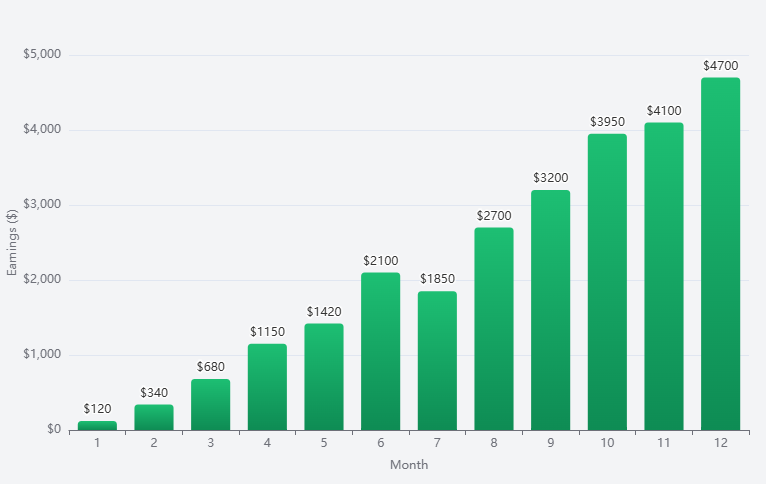
Notice the pattern? Months 1-3 were painfully slow. I almost quit in Month 2 when I earned just $340. But I kept optimizing, kept delivering excellent work, and kept showing up. The compounding effect of good reviews and algorithm trust kicked in around Month 5-6, and that’s when things really took off.
Total earnings over 12 months: $26,310 (after Fiverr’s commission). That’s an average of $2,192/month — and the trajectory was clearly upward. By Month 12, I was on pace for over $56,000/year.
Real talk: Imagine waking up on a random Tuesday morning, checking your phone, and seeing $200 in new Fiverr orders that came in overnight while you slept. That’s what happens once your gigs gain traction. It’s not “passive income” — you still have to do the work — but the client acquisition becomes increasingly automatic.
Common Mistakes That Kill Your Fiverr Success
Before we wrap up, let me save you from the mistakes I made (and see other sellers making constantly):
- Pricing too low to “get reviews” — You attract terrible clients and set a low-value precedent. Start at a fair price from Day 1.
- Copying other sellers’ gig descriptions — Fiverr’s algorithm can detect duplicate content, and buyers can tell when descriptions feel generic.
- Ignoring your response time — Fiverr tracks how quickly you reply to messages. A response time over 2 hours hurts your rankings. Aim for under 1 hour during work hours.
- Taking on work outside your expertise — It’s tempting to say “yes” to everything, but delivering mediocre work leads to bad reviews, which tanks your entire profile.
- Not asking for reviews — Many satisfied buyers simply forget to leave a review. A polite, non-pushy follow-up can double your review count.
- Neglecting your gig after publishing — Update your gig descriptions, thumbnails, and pricing quarterly. The market changes, and your gigs should evolve with it.
🎯 Stop Thinking, Start Doing
You’ve read the pros, the cons, the tips, and the real numbers. Now it’s decision time. Fiverr isn’t perfect, but it’s one of the fastest, lowest-risk ways to start earning money online in 2026. The only thing standing between you and your first client is action.
Join Fiverr today and create your first gig →
Free to join. No credit card required. You’ve got absolutely nothing to lose.
So, Is Fiverr Worth It in 2026? My Final Verdict
After years on the platform, hundreds of completed orders, and tens of thousands of dollars earned, here’s my honest answer: Yes, Fiverr is absolutely worth it in 2026 — but only if you treat it like a real business, not a get-rich-quick scheme.
Fiverr won’t make you wealthy overnight. It won’t replace your full-time income in a week. And it will test your patience during those early months when orders trickle in slowly. But if you commit to learning the platform, optimizing relentlessly, and delivering outstanding work, Fiverr can genuinely transform your financial life.
Here are the key takeaways:
- Fiverr removes the hardest parts of freelancing — client acquisition and payment processing — so you can focus on your craft
- Realistic first-year earnings range from $5,000-$25,000+, depending on your niche, pricing, and effort level
- Success requires patience — expect 2-3 months of building before consistent orders flow in
- Niche specialization and gig optimization are the two highest-leverage strategies for new sellers
- Use Fiverr as a launchpad, not your only income source — diversify over time for financial stability
The freelancers who succeed on Fiverr in 2026 aren’t necessarily the most talented — they’re the most consistent, strategic, and client-focused. If that sounds like you (or the person you want to become), then I genuinely encourage you to take the leap.
Browse top Fiverr gigs and create your free account here →
Your future self — the one checking their phone to find orders waiting — will thank you. Now stop reading and go publish that first gig. 🚀
For more strategies, success stories, and in-depth tutorials, don’t forget to explore our complete library of Fiverr resources.
Frequently Asked Questions About Fiverr
Can you really make money on Fiverr as a beginner?
Absolutely. Most beginners earn between $50-$500 in their first month, depending on their niche and effort. The key is starting with a well-optimized gig, competitive (but not cheap) pricing, and actively pursuing buyer requests. Many sellers report hitting $1,000+/month within their first 3-4 months of consistent work. It won’t be instant, but it’s very achievable.
How much commission does Fiverr take from sellers?
Fiverr takes a flat 20% commission on every completed order. So if you earn $100 on a project, you’ll receive $80. This percentage applies regardless of your seller level or order size. While it’s higher than some competitors, it covers the platform’s client acquisition, payment processing, dispute resolution, and infrastructure — services you’d otherwise need to pay for independently.
Is Fiverr safe and legit for freelancers?
Yes, Fiverr is a legitimate, publicly traded company (NYSE: FVRR) with millions of users worldwide. Payment is processed securely through the platform, and sellers are protected by Fiverr’s resolution center for disputes. That said, use common sense — never share personal financial information in messages, and always keep communication within the platform to maintain protection.
What are the best services to sell on Fiverr in 2026?
The highest-demand categories in 2026 include AI services, web development, video editing, SEO and digital marketing, copywriting, and UI/UX design. However, the “best” service to sell is ultimately one that matches your existing skills with strong buyer demand. Even seemingly niche skills — like spreadsheet automation, podcast editing, or resume writing — can be highly profitable with the right positioning.
How long does it take to get your first order on Fiverr?
This varies widely. Some sellers report receiving their first order within 24-48 hours, while others wait 2-4 weeks. The biggest factors are gig optimization (title, tags, description, thumbnail), your niche’s competition level, and whether you’re actively sending proposals through Fiverr’s “Get Briefs” feature. Proactive sellers tend to land their first order significantly faster than those who just “set it and forget it.”
Can you use Fiverr as a full-time job?
Yes — thousands of freelancers worldwide use Fiverr as their primary income source. Level 2 and Top Rated Sellers commonly earn $3,000-$10,000+ per month. However, I recommend building up to full-time gradually. Start Fiverr as a side hustle, and once your monthly earnings consistently exceed your expenses for 3-4 consecutive months, you can consider making the transition with confidence.


Leave a Reply